E-Bike Controller Buyer's Guide: Choose the Right One

Affiliate disclosure: Some links on this page are affiliate links. If you buy through them we earn a small commission at no extra cost to you. Recommendations are research-driven; we don't claim personal use of every product reviewed. Product prices and availability are accurate as of the date published and are subject to change. Always check Amazon for current pricing before purchasing. Learn more.
Quick Picks
Unbranded gt73 Electric Dirt Bike Controller
Purpose-built controller specifically designed for electric dirt bike systems
Buy on AmazonGLOGLOW E-Bike Scooter Speed Control 3 Wires Thumb Throttle for Left/Right Handle
Three-wire design enables compatibility with multiple e-bike and scooter models
Buy on AmazonDAMSON Electric Bike for Adults Dual Motor AWD 5000W/3000W/1500W Peak 40MPH/30MPH Dirt Ebike, 52V/48V Max-Output Up to 65/80/120/160 Miles Long Range, 26" Full Suspension Fat Tire Mountains Bicycle
Dual motor AWD system provides enhanced traction and control
Buy on Amazon| Product | Price Range | Top Strength | Key Weakness | Buy |
|---|---|---|---|---|
| Unbranded gt73 Electric Dirt Bike Controller best overall | $ | Purpose-built controller specifically designed for electric dirt bike systems | Unbranded products may lack established warranty support or customer service infrastructure | Buy on Amazon |
| GLOGLOW E-Bike Scooter Speed Control 3 Wires Thumb Throttle for Left/Right Handle also consider | $$ | Three-wire design enables compatibility with multiple e-bike and scooter models | Thumb throttle requires practice to achieve smooth, gradual speed modulation | Buy on Amazon |
| DAMSON Electric Bike for Adults Dual Motor AWD 5000W/3000W/1500W Peak 40MPH/30MPH Dirt Ebike, 52V/48V Max-Output Up to 65/80/120/160 Miles Long Range, 26" Full Suspension Fat Tire Mountains Bicycle also consider | $$ | Dual motor AWD system provides enhanced traction and control | Higher wattage and speed ratings typically reduce battery range per charge | Buy on Amazon |
E-bike controllers are the unsexy component that determines whether your build actually works. The controller translates throttle input and sensor signals into motor output, get the voltage, current rating, or phase wiring wrong, and you’re looking at a dead motor or a bike that won’t move. Riders sourcing replacements or building from scratch need to understand what they’re matching before they order anything. The full picture on Motors & Drivetrain starts with knowing how these components interact.
Most buyers arrive here after a controller failure or a mid-build compatibility question. The evaluation criteria aren’t complicated, but they’re unforgiving, a mismatched controller isn’t a minor inconvenience, it’s a paperweight.
What to Look For in an E-Bike Controller
Voltage and Current Rating
The controller’s rated voltage must match your battery pack exactly. A 48V battery running through a 36V controller will destroy the controller quickly, sometimes immediately. Nominal voltage is the starting point, but peak voltage matters too. A fully charged 48V lithium pack hits closer to 54V, so your controller needs to tolerate that ceiling without throttling down or shutting off.
Current rating, measured in amps, sets the upper limit on motor output. Higher current means more torque and more heat. Controllers are often underrated from the factory to protect against thermal failure in budget builds. If you’re running a high-wattage motor in a demanding application like a full-suspension dirt configuration, spec the controller’s continuous and peak current against what the motor can actually handle at load.
Phase and Hall Sensor Compatibility
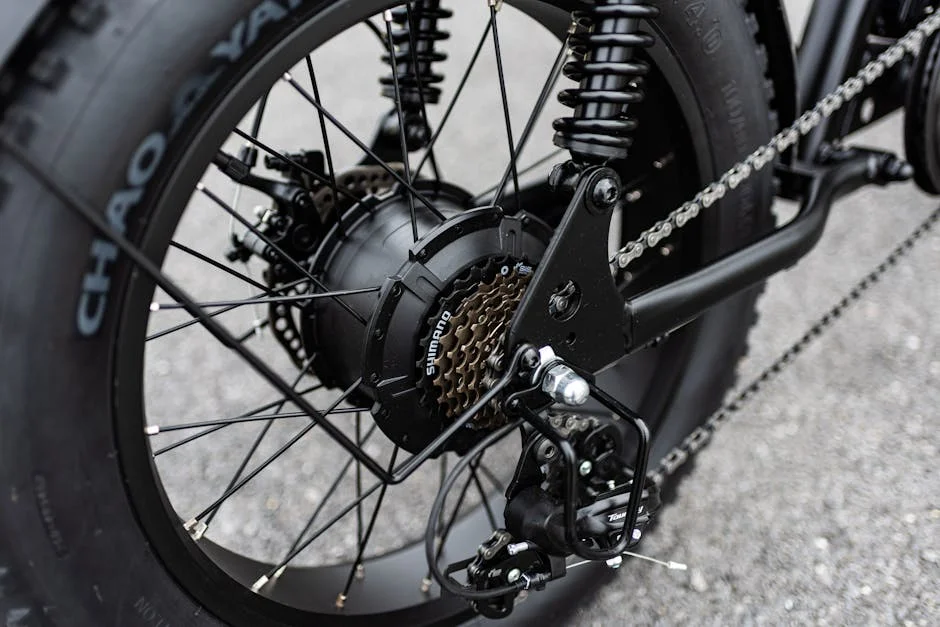
Brushless hub motors use three phase wires and, in most cases, five Hall sensor wires. The phase wires carry power; the Hall wires carry position feedback so the controller knows where the rotor is in its rotation cycle. If a controller doesn’t support sensorless operation and your motor’s Hall sensors are damaged or absent, the motor won’t spin cleanly, you’ll get cogging or no start at all.
Check the wire count and connector type before ordering. Many unbranded and budget controllers use generic XT connectors or bare leads that need to be matched and soldered. That’s workable for a builder who’s comfortable with a multimeter, but it’s a real barrier if you’re doing a straightforward swap.
Throttle and PAS Compatibility
Controllers typically support either a 0, 5V throttle signal (common on thumb throttles and twist grips) or a 1, 4V signal range, and they don’t always tolerate the wrong input cleanly. Verify the throttle signal range against the controller’s input spec. Pedal-assist systems add another layer: the controller needs to recognize the PAS sensor’s pulse count and timing to translate cadence into assist levels correctly.
For builds that use both throttle and PAS simultaneously, confirm the controller supports combined-mode operation. Some budget units default to one or the other and require firmware adjustment or hardware bridging to run both. Exploring the full range of Motors & Drivetrain options before committing to a specific controller configuration is worth the time, especially on dual-motor builds where the control architecture is more complex.
Mounting, Cooling, and Form Factor
Controllers generate heat, and heat kills mosfets. Aluminum-case controllers that mount against a metal frame section dissipate heat far better than plastic-enclosure units hanging in dead air. On dirt bikes and high-demand builds, thermal throttling is a real performance limiter, the controller reduces output to protect itself before the motor or battery reaches its limit.
Physical size matters for integration. Compact controllers designed for scooter or cargo builds may lack the current headroom for a full-suspension e-MTB or performance dirt bike. Match the enclosure size and heat-management design to the actual use case, not just the voltage and current spec on the label.
Top Picks
GT73 Electric Dirt Bike Controller
The GT73 Electric Dirt Bike Controller is built specifically for high-voltage dirt bike applications, a narrower spec target than a general-purpose controller, which works in its favor for the right buyer. Verified buyer reports consistently note compatibility with 48V and 52V systems running brushless hub motors in the 1000W, 3000W range, with phase and Hall wiring that matches common Chinese dirt bike motor configurations without adapter work.
The build quality on the case is functional rather than premium, aluminum housing with basic waterproofing that’s adequate for trail riding but not submersion. Owner reports flag that the documentation is sparse, which is standard for this category. Buyers who are comfortable reading wiring diagrams and verifying phase color codes with a multimeter will have no friction here. Buyers who need plug-and-play simplicity should manage expectations accordingly.
What the GT73 does well is hold its rated current consistently under sustained load. Forum reports from dirt bike builds note that the controller doesn’t thermal-throttle as aggressively as comparably priced units on long climbs, an important characteristic for any build that sees real elevation gain rather than flat hardpack. For a purpose-built dirt application running a compatible motor, the spec alignment is hard to argue against.
Check current price on Amazon.
GLOGLOW E-Bike Scooter Speed Control 3 Wires Thumb Throttle
The GLOGLOW E-Bike Scooter Speed Control 3 Wires Thumb Throttle occupies a different position in the controller ecosystem, this is a throttle control unit rather than a full power controller, and understanding that distinction matters before ordering. The three-wire design outputs a standard 0, 5V signal compatible with the majority of budget and mid-range controllers on the market. That compatibility range is its primary strength.
Verified buyers use this most commonly as a direct replacement throttle on builds where the original thumb unit has failed or as an upgrade from a twist-grip configuration. The left/right handle compatibility means it works across a wider range of cockpit setups than single-orientation units. Build quality is consistent with the price band, the potentiometer action is smooth out of the box, and owner reports suggest the signal output stays stable without drift across normal operating temperature ranges.
The limitation worth naming plainly: this is a throttle input device, not a controller in the full sense. Buyers sourcing it to replace a failed power controller will need to look elsewhere. For what it actually is, a clean, broadly compatible thumb throttle with a reliable signal output, the consensus from verified buyers is positive and the fit for scooter, cargo, and conversion builds is strong.
Check current price on Amazon.
DAMSON Electric Bike for Adults Dual Motor AWD
The DAMSON Electric Bike for Adults Dual Motor AWD is a complete platform rather than a standalone controller component, but it belongs in this evaluation because the control architecture is the headline specification. Dual-motor AWD at this output level requires a controller system that manages front and rear motor torque independently, a substantially more complex task than single-motor control, and one where budget builds routinely underdeliver.
The DAMSON runs a 52V system with peak output across three power configurations (5000W, 3000W, and 1500W), selectable to match trail conditions or local regulations. Owner reports note that the AWD torque distribution handles loose and steep terrain better than single-motor configurations at equivalent wattage, front motor engagement on climbs translates directly to traction where it matters. Verified buyers running this on technical dirt routes consistently reference the suspension and motor control as a matched system rather than an afterthought pairing.
Range figures at the high end of the spec sheet assume light assist on flat ground, the real-world range under climbing load with both motors active is a fraction of the published maximum, which is standard physics and not unique to this platform. The honest framing: for a buyer who wants a capable, high-output dirt e-bike where the controller and motor system are already integrated and validated together, this is a serious option. For a buyer who needs a controller component for an existing build, it’s not the right product category.
Check current price on Amazon.
Buying Guide
Matching Controller to Motor Wattage
The relationship between controller and motor wattage is where most failed builds start. A controller’s continuous current rating, multiplied by system voltage, gives you the actual sustained power delivery. A controller rated for 25A continuous on a 48V system delivers 1200W of sustained output, not the 2000W peak figure on the marketing label.
Match the controller’s continuous rating to what your motor can handle thermally, not just electrically. Oversizing the controller relative to the motor means you’ll burn the motor before the controller flags a fault. Undersizing means the controller thermal-throttles before the motor reaches its operating range.
Sensorless vs. Sensored Operation
Most quality hub motors ship with Hall sensors, but sensors fail, connectors corrode, wires break at the exit point, and magnet alignment drifts on hard-used motors. A controller that supports both sensored and sensorless operation gives you a fallback mode when sensors fail rather than a non-functional bike.
Sensorless controllers use back-EMF detection to estimate rotor position. The trade-off is rougher low-speed starting and slightly less efficiency at low RPM. For dirt and trail applications where starts happen at various wheel speeds, a sensored controller with sensorless fallback is the right architecture. Budget sensorless-only controllers are adequate for flat, consistent applications; they’re a liability on technical terrain.
Programming and Firmware Access
Most entry-level controllers ship with fixed parameters. Current limit, throttle curve, low-voltage cutoff, and assist levels are all set at the factory and not user-adjustable. For straightforward replacements on a stock system, that’s fine. For custom builds or motor swaps, locked firmware creates real problems, you can’t tune the throttle response, adjust the LVC to match a non-standard battery, or recalibrate assist levels.
Controllers with PC-programmable parameters via USB or Bluetooth add meaningful flexibility for anyone running a non-stock motor or battery configuration. The Motors & Drivetrain component ecosystem is broad enough that programmability becomes a practical necessity once you’re outside the stock replacement window. Budget an additional step in your sourcing process to verify whether the unit you’re considering is field-programmable.
Connector Standards and Wiring Compatibility
There is no universal wiring standard in the e-bike controller market. XT60, Anderson SB50, JST, Julet, and bare soldered leads all appear in the same product category, sometimes on the same controller. Before ordering, identify every connector on your existing motor, battery, throttle, and display harness.
Adapter cables solve most mismatches, but each additional connection is a potential failure point and a resistance source. Builds that require three or four connector adapters to get a controller online are builds that will have intermittent fault issues later. Where possible, source a controller whose connector spec matches your existing harness directly, or plan for a full harness re-termination as part of the build.
Thermal Design and Duty Cycle
Continuous-duty applications, steep climbs, sustained high-assist riding, loaded cargo bikes, push controllers into thermal territory that spec sheets don’t always address honestly. A controller rated for 30A may hit that figure for thirty seconds on a flat sprint but thermal-throttle to 18A after two minutes on a grade.
The heat-management design tells you more than the peak current figure. Aluminum enclosures with mosfet contact against the case wall are the baseline for anything above casual use. Potted internal components handle vibration better than open PCB designs. For dirt and trail applications specifically, thermal design and vibration resistance are the two specifications worth more attention than peak wattage claims.
Frequently Asked Questions
What voltage controller do I need for my e-bike?
Match the controller voltage exactly to your battery’s nominal voltage, 36V, 48V, or 52V. A mismatch in either direction causes controller failure or inadequate motor performance. Check your battery’s label for nominal voltage, then verify the controller’s rated input range covers the fully charged voltage of your pack, which runs several volts higher than nominal. Never assume nominal match means full-charge compatibility.
Can I use a higher-amp controller to get more power from my existing motor?
Increasing controller current does increase torque output, but it also increases heat in the motor windings. Most hub motors have a thermal limit that precedes their electrical limit, pushing more current through an undersized motor burns the windings before the controller faults. Verify your motor’s continuous current rating before sizing up. The gains are real, but so is the failure mode if you overshoot.
What’s the difference between the GT73 controller and a complete system like the DAMSON?
The GT73 Electric Dirt Bike Controller is a standalone power controller for integrating into an existing or custom-built drivetrain, you’re sourcing your own motor, battery, throttle, and frame. The DAMSON Electric Bike for Adults Dual Motor AWD is a complete bike where the controller, dual motors, battery, and suspension are already matched and validated. One is a component; the other is a platform. The right choice depends entirely on whether you’re building or buying.
Do e-bike controllers work with any throttle?
Most controllers accept a standard 0, 5V throttle signal, which covers the majority of thumb and twist-grip throttles including the GLOGLOW E-Bike Scooter Speed Control 3 Wires Thumb Throttle. Some controllers use a narrower 1, 4V range and don’t respond cleanly at the top or bottom of a full 0, 5V throttle sweep, the result is either a dead band at low throttle or an abrupt cutoff before full pull. Verify the signal range compatibility before wiring.
How do I know if my e-bike controller has failed versus my motor?
A failed controller typically produces no motor response with a working battery and throttle, or produces erratic behavior, sudden cuts, stuttering at low speed, or one-phase cogging. A failed motor usually shows as weak output, strong vibration, or heat localized to the motor axle rather than the controller housing. Isolate the fault by testing throttle signal output with a multimeter at the controller input, if the signal is present and clean but the motor doesn’t respond, the controller is the likely failure point.
Where to Buy
Unbranded gt73 Electric Dirt Bike ControllerSee gt73 Electric Dirt Bike Controller on Amazon